Guide
Total Solar Eclipse of August 2, 2027: Path, Times and Duration
The next total solar eclipse crosses the Strait of Gibraltar, North Africa and the Red Sea, with one of the longest totalities of the century at its greatest point.
What changed
- : First published.
On this page
The key numbers
From NASA's eclipse catalog for 2027:
| Item | Value |
|---|---|
| Date | August 2, 2027 |
| Greatest eclipse | 10:07 UT |
| Type | Total |
| Eclipse magnitude | 1.079 |
| Central duration | 6 minutes 23 seconds |
| Path width | 258 km |
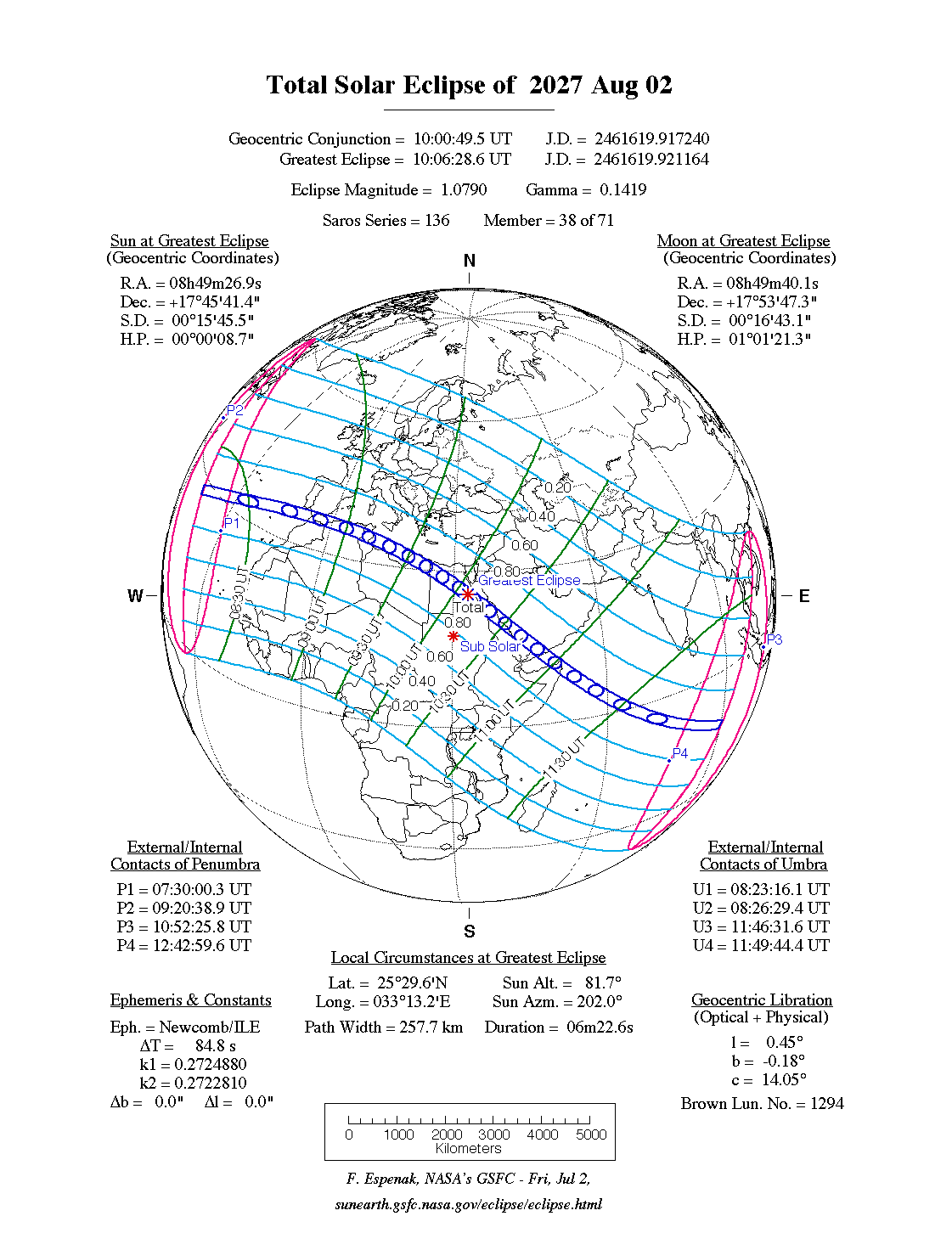
| Greatest eclipse point | 25.5° N, 33.2° E (southern Egypt) |
| Sun altitude there | 82° |
| Saros series | 136 |
Where it's total
NASA lists the path of totality across Morocco, Spain, Algeria, Libya, Egypt, Saudi Arabia, Yemen and Somalia. The path is 258 km wide at greatest eclipse. Inside it, the Moon completely covers the Sun for up to several minutes. Outside it, you see a partial eclipse.
NASA publishes a global map of the path (linked in the sources). Check it, or NASA's detailed path data, before choosing a location: whether you're inside the path, and how close to its center line, determines how long totality lasts.
Where it's partial
NASA's broader visibility region, where at least a partial eclipse can be seen, covers Africa, Europe, the Middle East and western and southern Asia. The farther you are from the path, the smaller the bite out of the Sun.
It is not visible from the Americas, Australia or East Asia.
Why it's special
Totality lasting 6 minutes 23 seconds at its greatest point is long by eclipse standards. For comparison, NASA's catalog lists the total solar eclipse of August 12, 2026 at 2 minutes 18 seconds and that of July 22, 2028 at 5 minutes 10 seconds at greatest eclipse. And the greatest point falls over land in southern Egypt, with the Sun 82° high, according to NASA.
Times in local terms
NASA gives 10:07 UT for greatest eclipse, which is at the point in southern Egypt. The eclipse reaches different places at different times along the path. Use NASA's local circumstances data for your exact location to get the start, totality and end times. To convert UT to your local time, add your UTC offset.
Before you go
- Eye protection. Every partial phase, before and after totality, requires ISO 12312-2 eclipse glasses or a handheld solar viewer, NASA says. Only during totality itself can you look directly. Read our eclipse eye safety guide.
- Skin protection. NASA notes you may be in direct sunlight for hours during an eclipse. In August in North Africa or the Middle East, plan for heat too: shade, water and sun protection.
- Weather. Clouds are the main thing that can ruin an eclipse view. Build some flexibility into your plans so you can move if the forecast is poor.
- Optics. Binoculars, telescopes and cameras need a solar filter attached to the front for the partial phases. Never use them with eclipse glasses.
What to watch for during totality
When the last sliver of Sun disappears, the sky darkens quickly. During totality you can see the Sun's faint outer atmosphere, the corona, which is normally hidden by the Sun's glare. When the Sun's edge reappears, totality is over: put your eclipse glasses back on immediately.
Other eclipses in 2027
NASA lists five eclipses in 2027: an annular solar eclipse on February 6, penumbral lunar eclipses on February 20, July 18 and August 17, and this total solar eclipse on August 2. All of them are in our eclipse calendar, filterable by region.
Common questions
Can I see the August 2, 2027 eclipse from the United States?
No. NASA's visibility region is Africa, Europe, the Middle East and western and southern Asia. NASA's catalog lists the next total solar eclipse after it on July 22, 2028, with totality over Australia and New Zealand.
How long is totality?
NASA gives a central duration of 6 minutes 23 seconds at the point of greatest eclipse. Elsewhere along the path it is shorter, and it drops toward zero at the edges.
Where is the longest totality?
NASA's point of greatest eclipse is at 25.5° N, 33.2° E, in southern Egypt, where the Sun is 82° high.
Is it visible from the UK?
NASA includes Europe in the partial eclipse region, but in Europe NASA lists only Spain in the path of totality. Elsewhere in Europe, it's a partial eclipse, which always needs eye protection.
Sources
- NASA Eclipse Web Site, Eclipses during 2027
- NASA Eclipse Web Site, Solar eclipses: 2021–2030
- NASA Eclipse Web Site, Total solar eclipse of 2027 Aug 02 (map)
- NASA Science, Eclipse viewing safety
Checked Nov 11, 2026. Spot an error? Tell us.